How much does buckthorn removal cost in Wisconsin?
In a yard, Angi says $50 to $150 per invasive shrub, and HomeGuide says $25 to $150 per bush. In the woods, HomeGuide prices brush removal at $800 to $5,000 per acre, depending on density. Its forestry mulching range is $400 to $800 per acre, or up to $2,000 for dense growth.
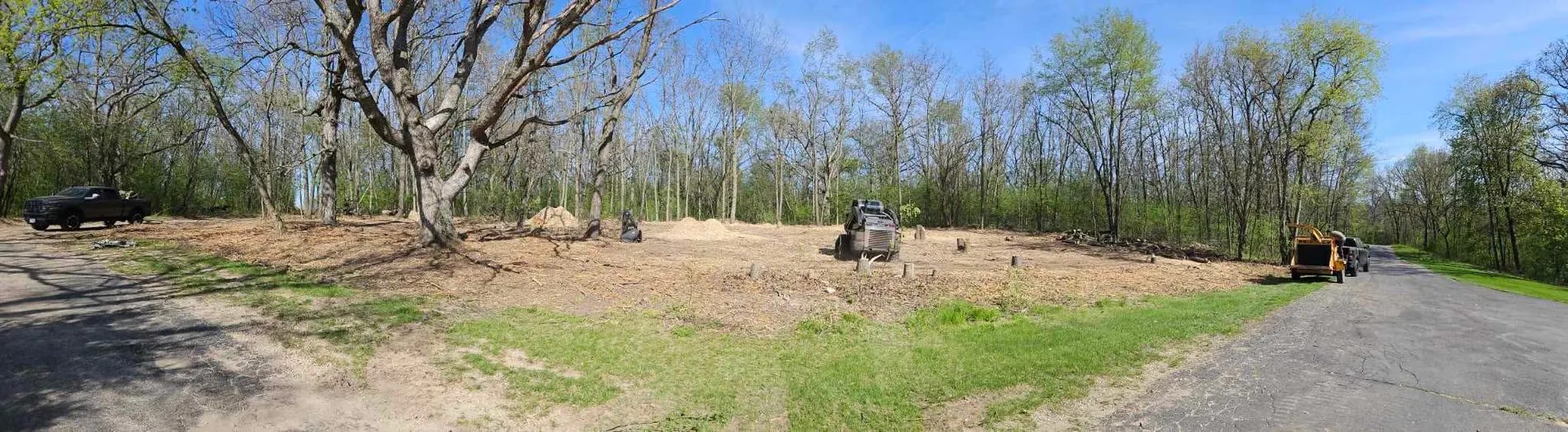
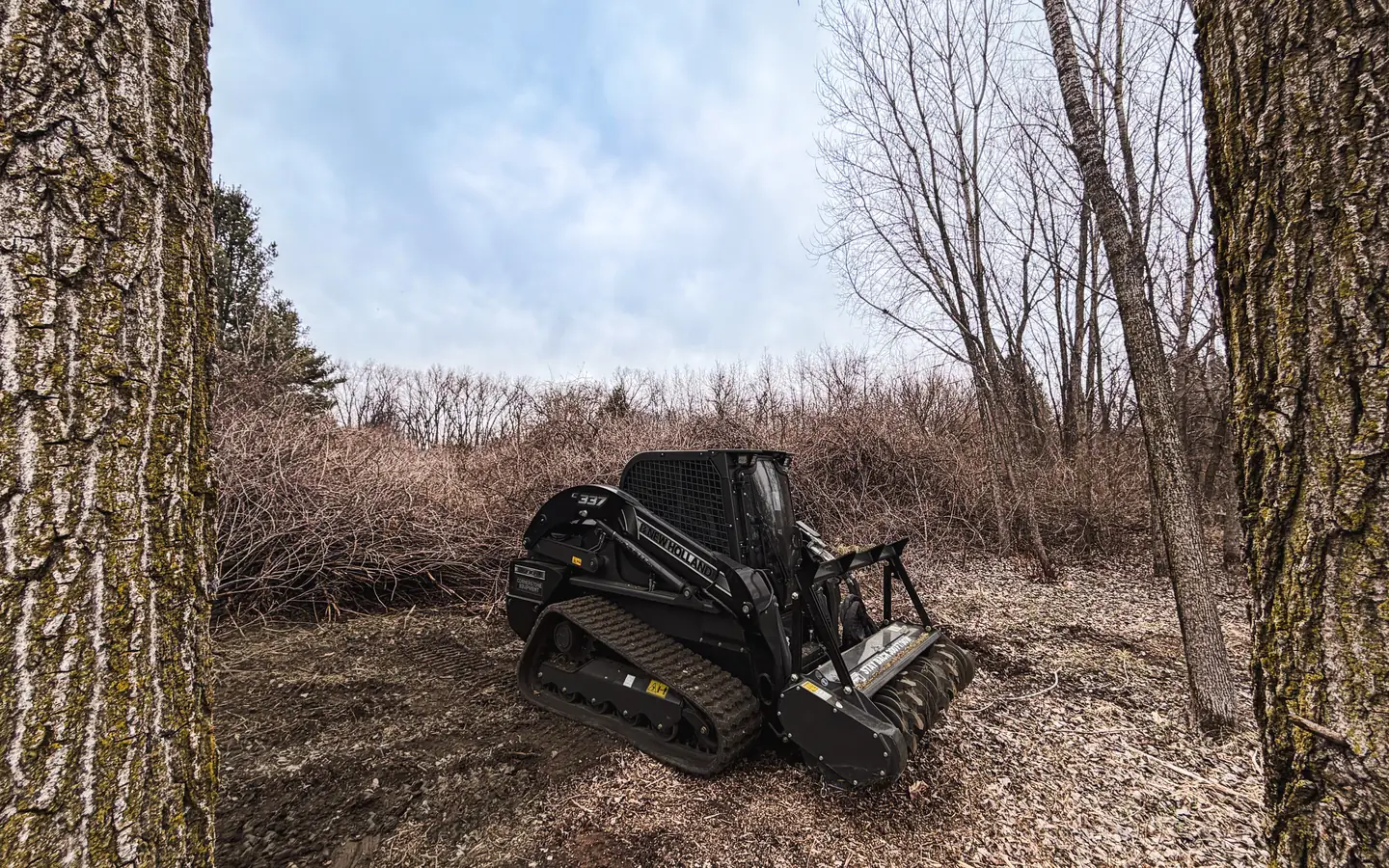
These are national cost guide ranges, and your number comes from a free on-site estimate. For buckthorn removal, we grind dense stands in place with a purpose-built forestry mulcher. It takes brush, saplings and small to mid-size trees in one pass. The mulch stays on the ground, and larger trees are cut and cleared first.
What does buckthorn removal cost per shrub?
Per-shrub pricing fits a yard or a few plants along a fence line. Angi’s shrub removal guide, updated Sep 11, 2026, lists invasive species at $50 to $150 per shrub. HomeGuide lists shrub and bush removal at $25 to $150 per bush.
| What you pay for | Publisher | Published range |
|---|---|---|
| Invasive shrub removal | Angi | $50 to $150 per shrub |
| Shrub and bush removal | HomeGuide | $25 to $150 per bush |
| Shrub removal labor | Angi | $45 to $100 an hour |
| Stump removal after the shrub | Angi | $150 to $350 per stump |
| Minimum fee per visit, brush removal | HomeGuide | $250 to $600 |
Stumps are a separate line in Angi’s guide. On a small job, the minimum fee per visit can set the bill.
You can pull the small ones yourself. The Wisconsin DNR says small plants may be hand-pulled. Larger plants can be dug or pulled with a leverage tool such as a weed wrench.
Per-shrub pricing stops making sense once buckthorn fills in. The DNR says glossy buckthorn can form dense, even-aged thickets. At that point, the woods get priced by the acre.
What does buckthorn removal cost per acre?
Per-acre pricing fits woods and fence rows where buckthorn has taken over. HomeGuide’s brush removal table climbs with the density of the growth. Its forestry mulching range sits lower.
| Ground or job | Publisher | Published range per acre |
|---|---|---|
| Light brush, few young trees | HomeGuide brush removal | $800 to $1,800 |
| Heavy brush, half brush and half trees | HomeGuide brush removal | $1,600 to $3,000 |
| Wooded, trees and brush | HomeGuide brush removal | $2,500 to $5,000 |
| Forestry mulching | HomeGuide | $400 to $800, up to $2,000 for dense growth |
| Invasive species control by mulching | Angi | $1,200 to $2,200 |
| Selective mulching that keeps chosen trees | Angi | $1,200 to $2,000 |
HomeGuide’s own project table puts clearing 10 acres of invasive trees at $4,000 to $8,000. Angi’s two mulching lines come from its forestry mulching guide, updated May 30, 2026.
By the hour, HomeGuide puts forestry mulching at $125 to $300. Small jobs meet its minimum fee of $400 to $600. Some companies add a $150 to $300 mobilization fee for setup.
Our forestry mulching cost guide breaks those numbers down by acre, hour and day.
What moves the price in southern Wisconsin?
Density comes first. HomeGuide says heavy overgrowth takes longer to mulch than light brush. The Wisconsin DNR says common buckthorn creates dense shade that stops the regeneration of tree seedlings.
Stem size is next. The DNR describes common buckthorn as a shrub or small tree up to 20 to 25 feet tall. It often grows several stems from the base.
HomeGuide’s hourly mulching rates climb with the size of the growth. Underbrush to small trees runs $125 to $200 an hour. Heavy brush with large mature trees runs $300 to $400.
Where it grows matters too. The DNR says common buckthorn invades oak forests, riparian woods, savannas and prairies. Glossy buckthorn invades wetlands, including bogs, fens and sedge meadows.
Slopes and wet ground slow the work. HomeGuide says steep slopes, rocky terrain and softer soils call for different equipment. Angi says steep slopes, rocky ground or wet areas can increase prep costs and slow the process. HomeGuide adds that brush in muddy or uneven terrain may have to be cleared by hand.
Trees that stay add time. HomeGuide says mulching around many trees increases difficulty and costs. Every oak and native shrub you keep is one more trunk to work around.
Access and setup matter on every job. HomeGuide says extra fees apply for removing fences to reach the property. Angi says prep work, such as marking property boundaries and removing large obstacles, can add $200 to $800. Angi also says a half-acre lot may cost more per acre than a five-acre project, because of mobilization and setup.
Why is the first clearing not the whole cost?
Buckthorn resprouts after it is cut. A University of Wisconsin-Extension buckthorn factsheet, linked from the DNR’s buckthorn page, says mowing rarely kills plants. It says established plants persist after mowing for many years.
It says cutting in summer, then again after the plant resprouts in fall, weakens next year’s resprouts. It adds that this will not kill the plants. The Wisconsin DNR lists a cut-stump treatment in late fall among its control methods.
So lasting control takes follow-up on the resprouts in the seasons after the first clearing. Put it in the budget as its own line. Angi’s forestry mulching guide lists weed or brush control at $200 to $600 an acre, annually or as needed. It lists re-mulching every 1 to 3 years at $500 to $1,500 an acre.
The mulch itself helps. UW-Extension says that when mowed material is mulched on the soil surface, it can reduce seedling recruitment. Our guide to clearing buckthorn in Wisconsin covers how to spot it and how the clearing works.
When is the best time to clear buckthorn?
Fall is when a buckthorn stand is easiest to see and price. The Wisconsin DNR says common buckthorn retains its leaves late into the growing season, longer than native plants. Its leaves stay green into fall.
Winter can suit the work too. UW-Extension suggests mowing buckthorn in winter when possible, to avoid damaging desirable vegetation and compacting soil. Angi lists scheduling mulching during off-peak seasons as one way to save.
Oaks set the other limit. The Wisconsin DNR puts the oak wilt risk window at April through July. Any oak that will be cut or wounded should wait until that window closes.
Does Wisconsin’s NR 40 rule change the cost?
It changes the method more than the price. Common buckthorn and glossy buckthorn are both classified as Restricted in Wisconsin under NR 40, the state’s invasive species rule. The DNR says restricted species cannot be transported, transferred or introduced without a permit. Possession is allowed, and control is encouraged but not required.
So you do not have to remove buckthorn, but moving it is the restricted part. That is why forestry mulching fits a buckthorn stand. The stems are ground where they grow, and HomeGuide says the mulch layer decomposes to improve the soil.
Buckthorn often has company. The DNR says Bell’s honeysuckle invades a broad range of habitats, including forest edges. When it shares the stand, it adds to the density you pay to clear.
Can the DNR help pay for buckthorn removal?
On larger woods, it might. The DNR’s Wisconsin Forest Landowner Grant Program reimburses up to 50% of the cost of eligible practices. You must own at least 10 contiguous acres of forest and no more than 500. You also need a forest stewardship plan in place, or an application to have one prepared through the program.
Whether buckthorn work counts as an eligible practice on your land is a question for your local DNR forester. Applications go to that forester for approval. Work completed before you receive an award letter is not eligible for reimbursement, so ask before the work starts.
FAQ
How much does buckthorn removal cost in Wisconsin? Published cost guides put it at $25 to $150 per shrub, or $400 to $5,000 per acre. Angi says $50 to $150 per invasive shrub, and HomeGuide says $25 to $150 per bush. HomeGuide prices brush removal at $800 to $5,000 per acre by density. Its forestry mulching range is $400 to $800, up to $2,000 when dense.
Is one clearing enough to get rid of buckthorn? Usually not, so budget for follow-up on the resprouts. A University of Wisconsin-Extension factsheet says mowing rarely kills established buckthorn, and the plants persist for years. The Wisconsin DNR lists a cut-stump treatment in late fall among its control methods. Angi’s forestry mulching guide puts weed or brush control at $200 to $600 an acre, annually or as needed.
Do I have to remove buckthorn in Wisconsin? No, but you cannot move it freely. Common and glossy buckthorn are Restricted species under Wisconsin’s NR 40 rule. The DNR says restricted species cannot be transported, transferred or introduced without a permit. Control is encouraged but not required. Forestry mulching fits that rule, because the stand is ground where it grows and the mulch stays on your land.
Does the time of year change what buckthorn removal costs? It can. Angi lists scheduling mulching during off-peak seasons as one way to save. Buckthorn holds its leaves late into the growing season, so fall makes a stand easy to see and price. Oak cutting waits outside the DNR’s oak wilt risk window of April through July. University of Wisconsin-Extension suggests winter mowing to avoid compacting soil.
Does the DNR help pay for buckthorn removal? It might, if you own 10 to 500 contiguous acres of forest. The DNR’s Wisconsin Forest Landowner Grant Program reimburses up to 50% of the cost of eligible practices. You need a forest stewardship plan, or an application for one. Ask your local DNR forester whether your buckthorn work qualifies. Work done before the award letter is not eligible.
Get a real number for your buckthorn
Your price comes from your stand and the trees you want to keep. Proper Grounds is a land clearing company based in Whitewater. We clear buckthorn across Walworth, Jefferson, Waukesha, Rock, Dane, Racine, Kenosha and Washington Counties. Book a free on-site estimate, and our price-match guarantee stands behind the number.