How much does forestry mulching cost per acre in Wisconsin?
Published cost guides put forestry mulching at about $400 to $2,500 per acre, or $125 to $300 an hour. HomeGuide puts a forestry mulcher with an operator at $1,000 to $2,500 a day. Open ground with light brush sits near the bottom of that range, and a buckthorn thicket sits near the top.
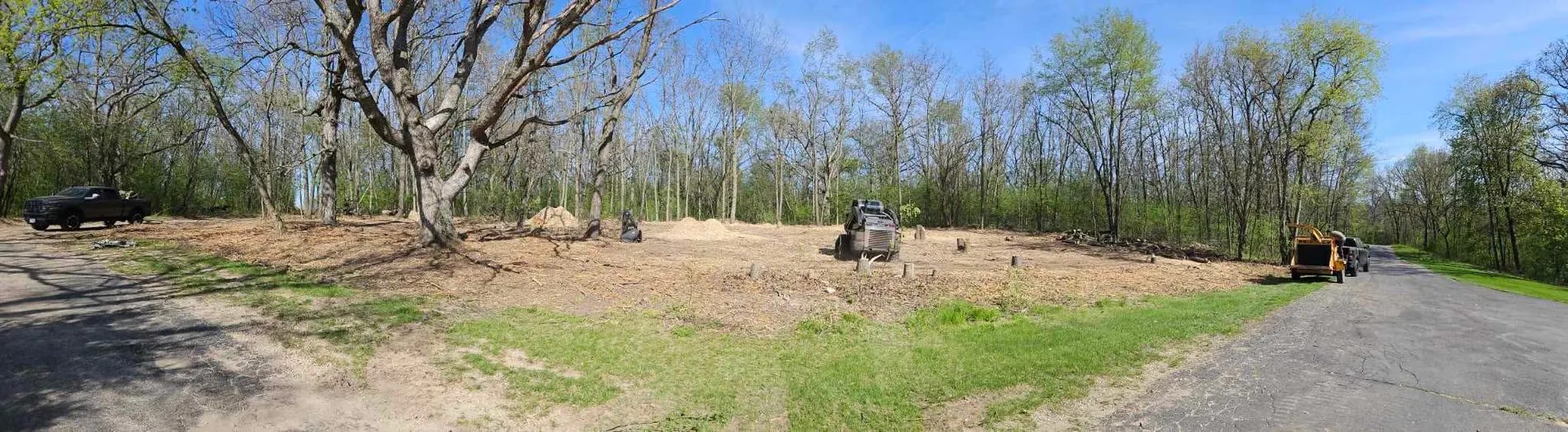
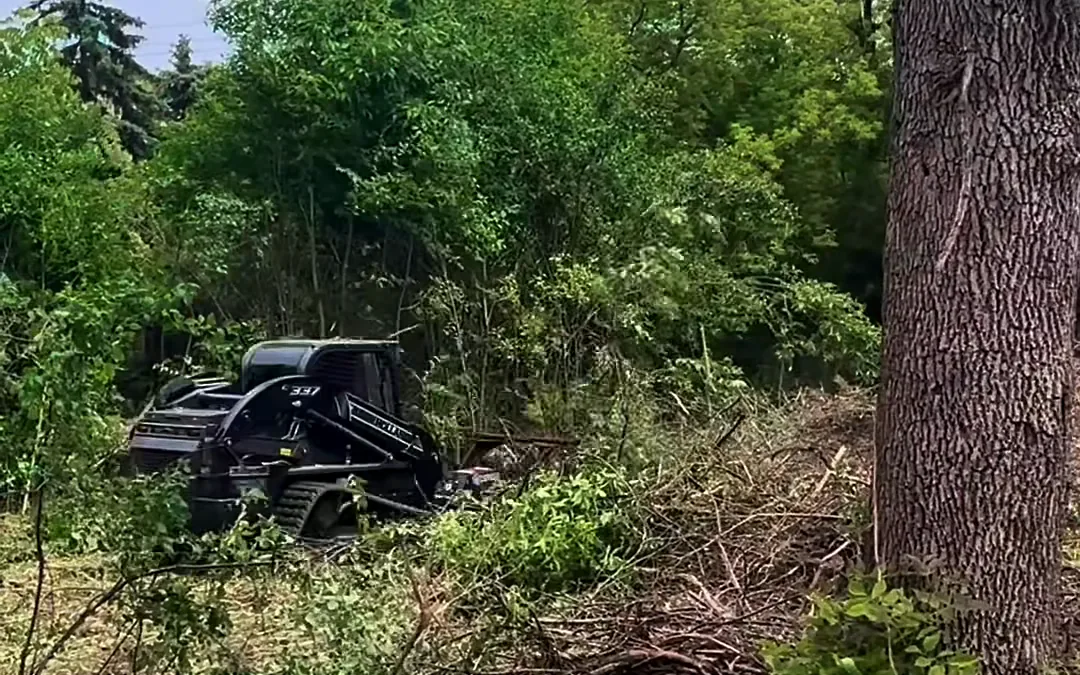
These are national cost guide ranges. Your number comes from a free on-site estimate. Our forestry mulching uses a purpose-built mulcher that grinds brush, saplings and small to mid-size trees in one pass. The mulch stays on the ground, and larger trees are cut and cleared first.
What does forestry mulching cost per acre?
The cost guides disagree, and Angi disagrees with itself. Its cost guide, updated May 30, 2026, says $1,000 to $2,500 an acre. Its explainer, updated July 9, 2026, says $400 to $600.
| Publisher | Cost per acre | Cost per hour |
|---|---|---|
| HomeGuide | $400 to $800, up to $2,000 for dense growth | $125 to $300 |
| Angi cost guide | $1,000 to $2,500 | $150 to $300 |
| Angi explainer | $400 to $600 average | Not given |
| LawnStarter | About $400 average | $150 to $250 |
The gap is mostly the growth. HomeGuide climbs from $400 to $800 an acre on average to $2,000 for high-density clearing. Angi’s project totals run from $500 for small, light jobs to $8,000 or more for large, dense acreage.
Our land clearing cost guide compares mulching with dozer work and other methods. An open field that only needs mowing is a bush hogging job, covered in our bush hogging cost guide.
What does forestry mulching cost per hour or per day?
Headline hourly rates run $125 to $300 across the three publishers. HomeGuide’s own hourly table climbs with the size of the growth. Underbrush to small trees runs $125 to $200 an hour. Heavy brush with large mature trees runs $300 to $400.
By the day, HomeGuide puts a forestry mulcher with an operator at $1,000 to $2,500. HomeGuide says a skid steer mulcher covers 1 to 3 acres a day. Large tractor mulchers clear up to 15. Angi’s explainer puts a forestry mulcher at one to five acres a day.
Small jobs hit a floor. HomeGuide lists minimum fees of $400 to $600, and some companies add a $150 to $300 mobilization fee for setup.
What does each type of forestry mulching cost?
Angi splits forestry mulching into four kinds of jobs. Each one is priced by the acre.
| Type of job | What Angi says it covers | Cost per acre |
|---|---|---|
| Brush removal | Undergrowth, small trees and shrubs | $1,000 to $1,800 |
| Selective mulching | Specific trees or brush, preserving others | $1,200 to $2,000 |
| Invasive species control | Non-native or harmful plants | $1,200 to $2,200 |
| Complete clearing | All vegetation and trees in the area | $1,500 to $2,500 |
Angi’s brush removal line matches our brush clearing. A buckthorn stand falls on the invasive species control line, our buckthorn removal work. Selective mulching sits between the two ends, and HomeGuide says mulching around many trees increases difficulty and costs.
Passes change the price too. Angi says a single pass is less expensive but may leave some material behind. Multiple passes give a cleaner finish and cost more.
What do 1, 5 and 10 acres of forestry mulching cost?
HomeGuide publishes totals by acreage. They rise in step with its $400 to $800 per acre.
| Acres | HomeGuide total |
|---|---|
| 1/2 acre | $200 to $400, at or under the $400 to $600 minimum |
| 1 acre | $400 to $800 |
| 2 acres | $800 to $1,600 |
| 5 acres | $2,000 to $4,000 |
| 10 acres | $4,000 to $8,000 |
Under an acre, the minimum fee sets the bill. Angi says a half-acre lot may cost more per acre than a five-acre project, because of mobilization and setup.
Angi’s size table runs higher. It puts one acre at $1,200 to $2,500 and five acres at $5,000 to $10,000.
Is renting a forestry mulcher cheaper than hiring one?
Renting can cost as much as hiring. Angi’s explainer puts a rental at $1,200 to $3,000 a day plus insurance and transport. Its cost guide lists rental at $500 to $1,200 a day, before fuel, safety gear and permits.
Angi’s $3,000 top is more than HomeGuide’s $1,000 to $2,500 for a hired day with an operator. Depending on the rental source, Angi’s explainer says, you may need to be a registered business or farmer.
What pushes the price up on southern Wisconsin land?
Density comes first. The Wisconsin DNR says common buckthorn invades oak forests, riparian woods, savannas and prairies, and creates dense shade. Bell’s honeysuckle, per the DNR, invades a broad range of habitats, including forest edges.
HomeGuide says heavy overgrowth takes longer to mulch than light brush. Our guide to clearing buckthorn in Wisconsin covers timing and regrowth.
Slopes come next, and the Kettle Moraine has plenty. The DNR says it formed where two glacier lobes met, on a line running northeast from Richmond in Walworth County. Its ground runs to steep-sided ridges and conical hills.
Angi says slopes help set the timeline, and HomeGuide says steep slopes and softer soils need different equipment. Angi counts wet areas as terrain that raises prep costs.
Standing dead ash adds time. UW Madison Extension says emerald ash borer has killed more than 90% of the ash in the state’s southern third. Trees too big for the mulcher are cut and cleared first. Extension adds that invasive plants can exploit the open areas ash borer leaves in the canopy.
Near a lake or stream, a permit can come before the mulcher. Waukesha County, for one, wants a vegetation removal permit for certain cutting in its shoreland areas. Those areas run generally within 1,000 feet of a lake or 300 feet of a stream.
The county’s application needs a cutting plan, and it says to expect the permit in about two weeks. Nationally, HomeGuide puts land clearing permits at $100 to $500 on average. Our land clearing permit guide covers when the rules apply. Check with the county or your city or village hall before work starts.
Does the time of year change the price?
It can. Angi lists scheduling mulching during off-peak seasons as one way to save.
Low, wet ground often waits for frost. UW Madison Extension says operators typically need frozen ground days to prevent soil rutting in lowland stands. It also reports a decline in the number of frozen ground days across Wisconsin. Winter slots on wet ground are worth booking early.
The Wisconsin DNR says oak wilt spreads most in spring and early summer, April through July. That is when sap-feeding beetles carry spores to fresh wounds or to recently cut oak stumps. The DNR calls oak wilt widespread in southern Wisconsin. If oaks will be cut or wounded, plan that work for August through March.
What does a forestry mulching price leave out?
Stumps are the first separate line. Angi’s explainer says mulching grinds trees to ground level without removing the roots underground. It says larger or deep-rooted stumps may need a dedicated stump grinder. HomeGuide puts stump removal at $100 to $400 per stump, and our stump grinding cost guide covers the rest.
The mulch is the cleanup. LawnStarter says mulching spares you debris removal costs, because the mulch can remain on the ground. Angi still tells readers to budget $200 to $1,000 before mulching starts, for permits, stump grinding, hauling and erosion control.
Grading is the last separate line. If a building lot needs rough grading after the mulcher, that is its own job.
Can the DNR help pay for forestry mulching?
Sometimes, if you own at least 10 contiguous acres of forest and no more than 500. The DNR’s Wisconsin Forest Landowner Grant Program reimburses up to 50% of the cost of eligible practices. You also need a forest stewardship plan in place, or an application for one.
Forest health and improvement is one of the program’s priority practices. Your local DNR forester approves applications, so ask whether your mulching work qualifies. Work completed before the award letter is not eligible for reimbursement. Most projects are funded each year on August 1.
FAQ
How much does forestry mulching cost per acre in Wisconsin? Published cost guides put it at about $400 to $2,500 per acre. HomeGuide says $400 to $800, or up to $2,000 for high-density growth. Angi’s cost guide says $1,000 to $2,500, its explainer says $400 to $600 and LawnStarter says about $400. Open ground with light brush lands low, and a buckthorn-choked woodlot lands high.
What does forestry mulching cost per hour or per day? Hourly rates in the published guides run $125 to $300. HomeGuide says $125 to $300, Angi says $150 to $300 and LawnStarter says $150 to $250. By the day, HomeGuide puts a forestry mulcher with an operator at $1,000 to $2,500. Small jobs hit HomeGuide’s minimum fee of $400 to $600.
Does forestry mulching remove stumps? Not fully, and the mulcher matters. HomeGuide says drum mulchers grind stumps to the ground, while disc mulchers leave stumps visible. Angi’s explainer says mulching leaves the roots underground, and larger or deep-rooted stumps may need a dedicated stump grinder. Budget stump grinding as its own line if the stumps must go.
Is it cheaper to rent a forestry mulcher? Not always. Angi’s explainer puts a rental at $1,200 to $3,000 a day plus insurance and transport. Its cost guide says $500 to $1,200. HomeGuide puts a mulcher with an operator at $1,000 to $2,500 a day. Angi adds that some rentals may require you to be a registered business or farmer.
Does the DNR help pay for forestry mulching in Wisconsin? It can, for eligible practices, if you own at least 10 contiguous acres of forest and no more than 500. The DNR’s Wisconsin Forest Landowner Grant Program reimburses up to 50% of the cost. You need a forest stewardship plan or an application for one. Work done before the award letter is not eligible, so talk to your local DNR forester first.
Get a real number for your woods
Your price comes from your growth and your ground. Book a free on-site estimate and we will price your acreage, with our price-match guarantee behind it. Proper Grounds works across eight southern Wisconsin counties from Whitewater.