How do you clear buckthorn and invasive brush in Wisconsin?
Buckthorn is one of the worst invasive plants in southern Wisconsin woods, and clearing it takes more than a chainsaw. Cut a buckthorn stump and it comes back thicker, as a cluster of new stems. The reliable fix pairs mechanical clearing, either mulching a dense stand or cutting it, with a herbicide on the stump, done in late fall when the plant is sending sugars down to its roots. Get the timing and the follow-up right and it stays gone.
If buckthorn has swallowed your woods or fence line around Whitewater or Walworth County, here is what you are dealing with and how land clearing actually beats it.
Why buckthorn is such a problem here
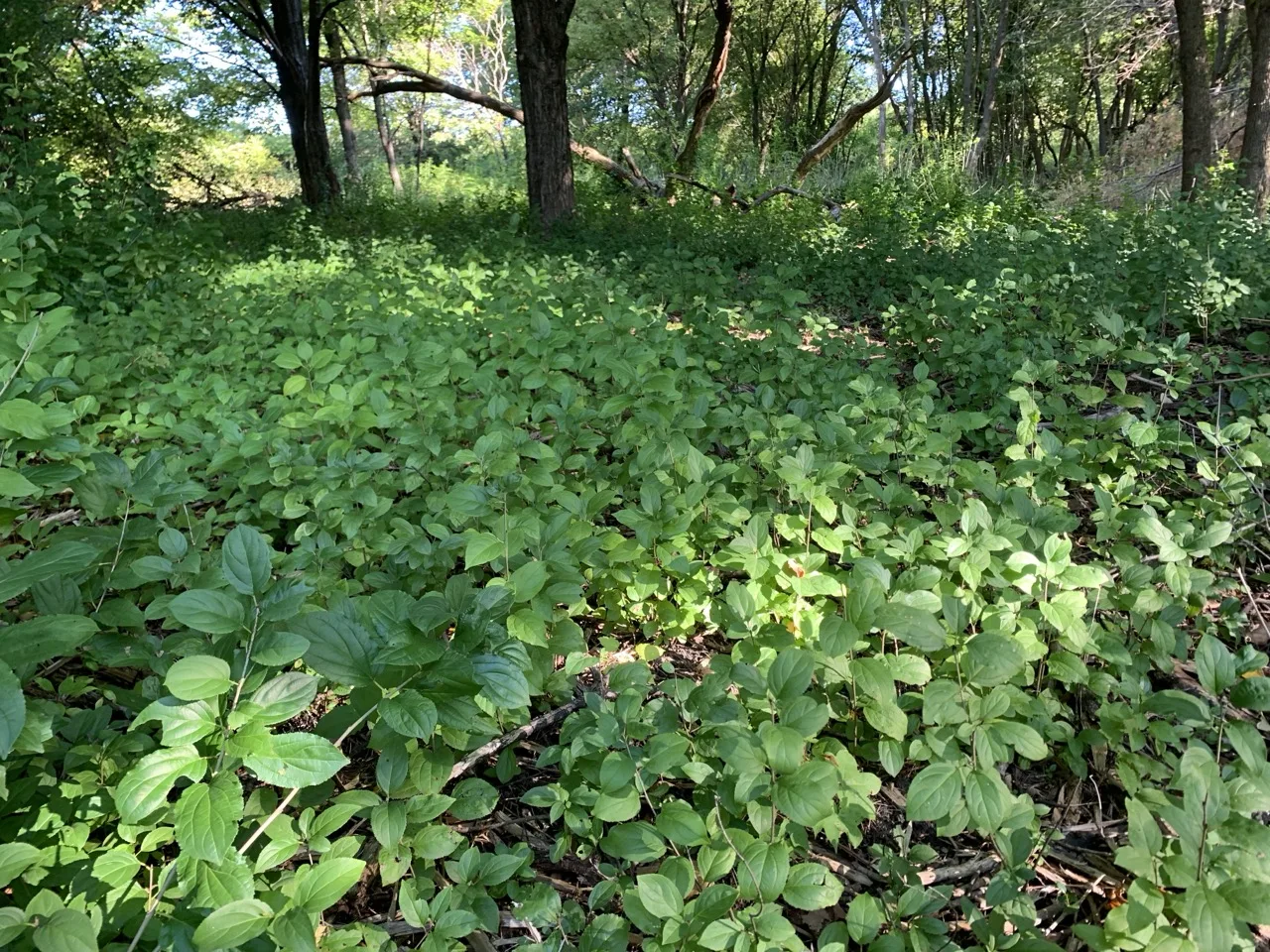
Buckthorn took over southern Wisconsin for a few reasons that all work against a property owner. It leafs out early and holds its leaves late, so it shades the forest floor longer than native plants and crowds out their seedlings. It grows in dense, even-aged thickets that turn an open woods into an impassable wall. It produces heavy crops of dark berries that birds spread far and wide, seeding new plants across the property. And it releases compounds that make it harder for native plants to grow nearby.
There is an agricultural angle too. Common buckthorn is the alternate host for crown rust of oats and the overwintering host for the soybean aphid, so a thicket on the back acres is not just a woodland problem.
How to spot it
Wisconsin has two species, and both are common around here. Common buckthorn grows as a shrub or small tree up to about 20 to 25 feet, often with a short thorn at the tips of its twigs and toothed leaves whose veins curve toward the tip. Glossy buckthorn has no thorns, with oval, glossy leaves that have smooth, untoothed edges, and bright orange-yellow inner bark when you cut a stem. Common buckthorn favors uplands and oak woods; glossy buckthorn leans toward wet ground, bogs, and wetland edges.
The easiest tell shows up in late fall. After the native trees and shrubs have dropped their leaves, the buckthorn is still green. Stand at the edge of the woods in November and the green is almost all buckthorn, which is exactly why fall is the time to deal with it.
Why cutting alone makes it worse
Here is the trap. Cut a buckthorn down and leave the stump, and it resprouts vigorously, sending up multiple new stems from the base. You end up with a thicker, bushier plant than you started with. The same goes for running a mower or a mulcher through a stand without any follow-up: you clear the view for a season, then it comes roaring back.
That is the single most important thing to understand about buckthorn. The plant lives in the roots, so killing the top without treating the root just prunes it.
How buckthorn actually gets cleared
Lasting control combines removing the growth with killing the root. The right mix depends on how dense and how big the stand is.
| Method | Best for | How well it works | Regrowth risk |
|---|---|---|---|
| Hand-pulling or a weed wrench | Small seedlings and saplings, moist soil | High on small plants | Low if the whole root comes out |
| Cut-stump plus herbicide | Medium to large stems | Very high, the standard | Low when treated promptly |
| Forestry mulching or brush mowing | Large, dense thickets | Clears it fast, but does not kill roots alone | High unless paired with herbicide |
| Foliar spray | Resprouts and smaller plants | High on reachable leaves | Low to moderate, may repeat |
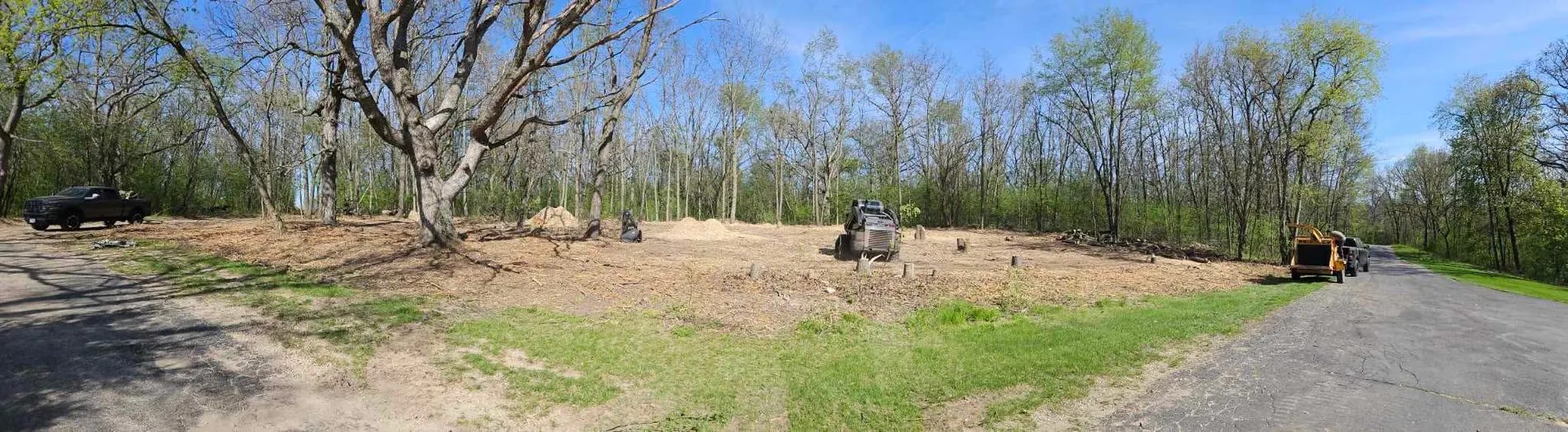
For a wall of mature buckthorn, the practical route is to mulch or mow the stand down with forestry mulching, then treat the resprouts. For scattered medium and large stems, cut-stump treatment handles it in one pass. The point is that the mechanical clearing and the herbicide work together; neither finishes the job alone. The same approach covers general brush clearing and our other clearing methods lay out where each fits.
The best time of year
Late fall is the window. The buckthorn is still in leaf and easy to find, the plant is moving sugars down to the roots so a cut-stump herbicide rides along to where it does the most good, and the native plants are dormant, so there is little risk to them. Cut-stump and basal-bark treatments can carry on into winter, and mulching a heavy stand is often best on frozen ground, which carries the equipment without tearing up the soil. Spring, when the plant is pushing leaves out, is the weakest time to treat.
Other invasive brush in southern Wisconsin
Buckthorn rarely travels alone. The same acres often carry bush honeysuckle, multiflora rose, and autumn olive, and all of them respond to the same playbook: clear the growth, then treat the stump or the resprout.
Wisconsin lists buckthorn as a restricted species under its NR 40 invasive species rule, and honeysuckle is restricted here in the southern part of the state. Restricted is worth understanding: the state strongly encourages you to control these plants, but it does not legally require you to remove them from your land. What is against the rules is moving, selling, or planting them. So no one is going to make you clear your woods, but between the spread, the lost native habitat, and the impassable thickets, there is every reason to.
FAQ
What is the best time of year to cut and treat buckthorn? Late fall is the best window. Buckthorn holds its green leaves long after native plants have dropped theirs, which makes it easy to spot, and in fall the plant is moving sugars down to its roots, so a herbicide applied to a cut stump travels where it needs to go. The natives are dormant too, so there is less collateral damage. Cut-stump and basal-bark work can continue into winter.
Will buckthorn grow back after you cut it down? Yes, aggressively, if you only cut it. A cut buckthorn stump resprouts into a multi-stemmed clump that comes back thicker than before. That is why cutting or mulching alone does not solve it. Lasting control pairs the mechanical removal with a herbicide on the cut stump or the resprouts, or repeated cutting over several seasons.
Do you have to use herbicide to kill buckthorn, or can you just cut it? You can avoid herbicide, but it takes far more work. Without it, you are looking at repeated cutting every few weeks through the growing season for two or more years, or covering the cut stumps to starve them. A single cut-stump herbicide treatment is the standard because it kills the root system the first time. For dense stands, mulching plus a follow-up treatment is the practical route.
How do you tell common buckthorn from glossy buckthorn? Common buckthorn grows as a shrub or small tree to about 20 to 25 feet, often with a small thorn at the twig tips and dull-to-glossy toothed leaves with curved veins. Glossy buckthorn has no thorns, with oval glossy leaves that have smooth, untoothed edges and bright orange-yellow inner bark when cut. Common buckthorn favors uplands and woods; glossy buckthorn leans toward wet ground.
Is buckthorn illegal in Wisconsin? Buckthorn is listed as a restricted invasive species under Wisconsin’s NR 40 rule. Restricted means the state strongly encourages control but does not legally require you to remove it from your land. What is illegal is transporting, selling, transferring, or planting it. So you are not forced to clear it, but there is good reason to.
Does forestry mulching kill buckthorn, or does it come back? Mulching is the fast way to knock down a dense buckthorn stand, but on its own it does not kill the plant; the roots survive and resprout. To make it stick, the mulching is paired with a herbicide treatment on the resprouts or cut stumps. Done together, you get the thicket cleared now and the regrowth controlled.
Take your woods back
A buckthorn thicket does not clear itself, and half-clearing it just feeds the regrowth. Proper Grounds handles buckthorn removal and invasive brush clearing across Whitewater, Lake Geneva, Elkhorn, and Walworth County, with the equipment to knock down a dense stand and the plan to keep it from coming back. Ask for a free on-site estimate and we will walk your property and lay out what it takes to get it open again.